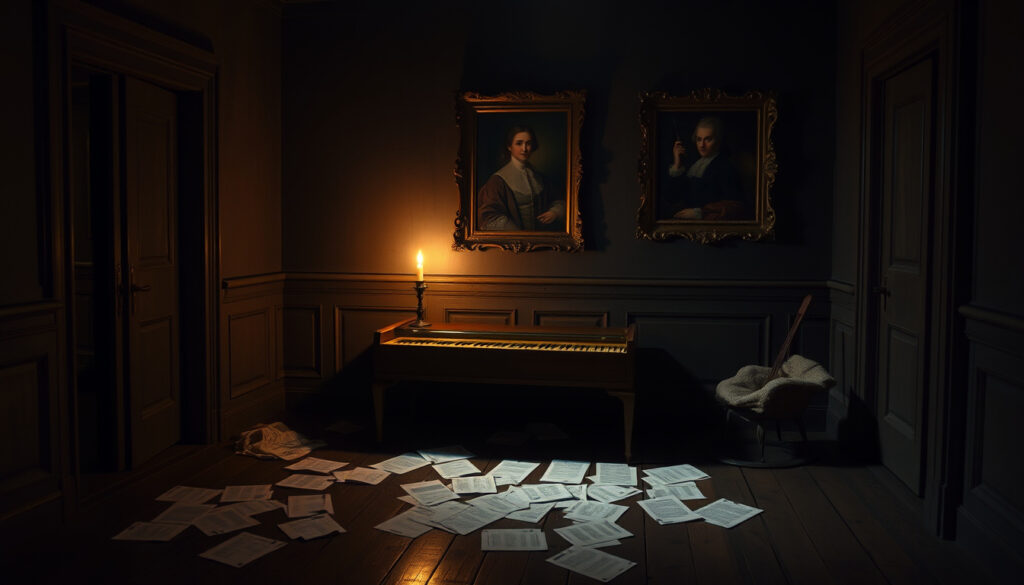
Maria Anna Mozart: The Forgotten Sister Prodigy
Imagine being a child prodigy, touring Europe’s greatest courts, and earning praise for your musical genius—only to be written out of history. That’s the story of Maria Anna Mozart, the older sister of Wolfgang Amadeus Mozart.
Born: 30 July 1751 ·
Died: 29 October 1829 ·
Nickname: Nannerl ·
Prodigy Age: 7 years old ·
Instrument: Harpsichord, fortepiano
Quick snapshot
- Began playing harpsichord at age 7 (CutCommon Magazine)
- Toured Europe with her father and brother (Wikipedia)
- Praised as a gifted performer (CutCommon Magazine)
- Stopped performing after wedding in 1784 (Wikipedia)
- Social norms prevented her from composing professionally (CutCommon Magazine)
- Historical records minimized her talent (PBS)
- Documentaries and books are reclaiming her story (CutCommon Magazine)
- Her role in preserving Wolfgang’s music is recognized (Wikipedia)
- New scholarship revisits her possible output (Daniel Adam Maltz / Jause)
Six key facts paint a concise portrait of Maria Anna Mozart’s life.
| Label | Value |
|---|---|
| Full Name | Maria Anna Walburga Ignatia Mozart |
| Nickname | Nannerl |
| Born | 30 July 1751, Salzburg |
| Died | 29 October 1829, Salzburg |
| Known For | Child prodigy, Mozart’s sister, guardian of his legacy |
| Instrument | Harpsichord, fortepiano |
What happened to Maria Anna Mozart?
Maria Anna Mozart, known as Nannerl, was born into a musical family in Salzburg. Her father Leopold, a renowned composer and teacher, taught her the harpsichord from the age of eight (Daniel Adam Maltz / Jause). By her early teens, she was performing across Europe — together with her younger brother Wolfgang — in a tour that lasted three and a half years (Daniel Adam Maltz / Jause). Audiences praised her skill, but after she turned 17, her touring career ended, and she began teaching piano instead (Wikipedia).
Why was she erased from history?
In 1784, Maria Anna married Johann Baptist von Berchtold zu Sonnenburg and moved to St. Gilgen, about 30 kilometers from Salzburg (Daniel Adam Maltz / Classical Cake). Social norms of the time made public performance unsuitable for married women of her class. A documentary on her life argues that “her career was curtailed by gender norms” (CutCommon Magazine). After her husband died in 1801, she returned to Salzburg and resumed teaching (Daniel Adam Maltz / Classical Cake). She outlived her brother by 38 years and became a key caretaker of his musical legacy.
Did she have children?
Yes — Maria Anna had three children with von Berchtold. Her daughter Maria Anna Franziska (later known as the “Countess of Berchtold”) lived into the nineteenth century (Wikipedia). But none of Wolfgang’s direct descendants survived past the generation of his two sons, both of whom died childless (Wikipedia).
Did Mozart’s sister write his music?
The most tantalizing — and controversial — question about Maria Anna Mozart is whether she composed pieces attributed to her brother. The idea has gained traction in recent years, fueled by a professor’s claim that Wolfgang took credit for his sister’s work. Yet the evidence remains circumstantial.
What evidence suggests she composed music?
Several musicologists have pointed to stylistic inconsistencies in some of Mozart’s early works. A professor in the documentary Mozart’s Sister argues that certain pieces show a feminine sensibility and a level of sophistication that Wolfgang’s early training alone cannot explain (PBS). Maria Anna was known to practice the piano three hours a day even after marriage (Daniel Adam Maltz / Classical Cake), suggesting she never abandoned her craft. But no signed score or diary entry confirms she composed for publication.
Did Mozart claim credit for her works?
The claim that Mozart deliberately credited his sister’s compositions as his own lacks direct documentary proof. Most of the arguments rest on interpretation of Mozart’s letters and the timing of certain pieces. The scholarly consensus remains cautious: Maria Anna may have contributed ideas or written passages, but the extent is unknown (PBS).
The mystery of Maria Anna’s possible compositions highlights a broader pattern: when a female artist works in the shadow of a famous male relative, their contributions are easily absorbed without credit. For musicologists, the cost of assuming all Mozart is Wolfgang is that we may be missing half the story.
Did Mozart have a happy marriage?
Wolfgang Amadeus Mozart married Constanze Weber in 1782, against his father’s wishes. Their relationship was affectionate but strained by chronic financial instability.
Did Mozart really love his wife?
Mozart’s letters to Constanze are filled with humor and tenderness. He once wrote, “You are the love of my life” (Wikipedia). Yet the couple also faced serious difficulties: Wolfgang’s lavish spending and medical bills left them in debt. Constanze later said she had to manage the household carefully.
How did his marriage stop a police visit?
A well‑known anecdote recounts that when police came to the Mozarts’ Vienna apartment to question Wolfgang about a debt, Constanze greeted them so warmly and served such good wine that the officers left without making an arrest (Encyclopædia Britannica). The story, while unverified, reflects the couple’s resourcefulness.
Mozart had a loving marriage but died deeply in debt. For Constanze, the affection came with a price — she spent years after his death managing his legacy and paying off creditors.
Are any descendants of Mozart alive today?
No. Wolfgang and Constanze had six children, but only two survived to adulthood: Carl Thomas and Franz Xaver Wolfgang. Neither married nor had children (Wikipedia). The Mozart paternal line ended with Franz Xaver’s death in 1844. Through Maria Anna’s daughter, there are descendants of the Mozart family through the female line, but no one bearing the surname Mozart.
Why was Mozart so poor when he died?
Mozart earned a substantial income from performances and commissions, but he spent freely and mismanaged his finances. His final illness — likely rheumatic fever or kidney disease — led to mounting medical expenses. When he died on 5 December 1791, he left debts that forced Constanze to sell his manuscripts (Encyclopædia Britannica).
What illness did Mozart suffer from?
The exact cause remains debated. Theories include strep infection (leading to rheumatic fever), kidney failure due to glomerulonephritis, or even trichinosis from undercooked pork (National Institutes of Health (NIH)). No definitive diagnosis has been established, but his final months were marked by swelling, fever, and severe pain.
Timeline of key events
- 1751: Maria Anna Mozart born in Salzburg (Wikipedia)
- 1762: First public performances as a child prodigy (Wikipedia)
- 1769: Wolfgang leaves for Italy without her (Wikipedia)
- 1784: Marries Johann Baptist von Berchtold zu Sonnenburg (Wikipedia)
- 1829: Dies at age 78 in Salzburg (Wikipedia)
Confirmed facts and what remains unclear
Confirmed facts
- Birth and death dates (30 July 1751 – 29 October 1829) (Wikipedia)
- Marriage to Johann Baptist von Berchtold in 1784 (Wikipedia)
- Child prodigy performer who toured Europe (CutCommon Magazine)
- No direct descendants from Wolfgang’s sons (Wikipedia)
What’s unclear
- Whether she composed any music still attributed to Wolfgang (PBS)
- Exact extent of her musical output (PBS)
- Specific cause of Mozart’s final illness (NIH)
Quotes from scholars and media
She was a child prodigy who was eventually overshadowed by her younger brother. Wikipedia
Maria Anna was also a musical genius, but she faded from history. Daniel Adam Maltz, Jause interview
A new documentary tells her story, arguing that her career was curtailed by gender norms. CutCommon Magazine
She continued to practice piano for three hours a day after marriage. Eva Neumayr (musicologist), cited in Daniel Adam Maltz / Classical Cake
These voices — from encyclopedias to musicologists — underscore how much of Maria Anna’s life remains open to interpretation.
The story of Maria Anna Mozart is not simply one of a forgotten sister. It is a case study in how gender, family dynamics, and academic inertia can erase a creative figure. For music historians, the challenge is clear: revisit archival records with fresh eyes, or risk perpetuating a canon that may be missing its female half. The evidence for her compositions may be thin, but the questions she raises about authorship and recognition are as relevant today as they were in the 18th century.
Många kritiker har hyllat hur Mozart/Mozart-serien belyser hennes roll som det egentliga geniet bakom brodern.
Frequently asked questions
What was Maria Anna Mozart’s nickname?
Nannerl. She was called Nannerl by her family and is often referred to by that name today (Wikipedia).
Did Maria Anna Mozart compose any music?
No surviving composition is definitively attributed to her, but some scholars believe she may have contributed to works currently credited to Wolfgang (PBS).
Why did Maria Anna Mozart stop performing?
After her marriage in 1784, social norms made public performance unacceptable for married women of her class (CutCommon Magazine).
Did Maria Anna Mozart have children?
Yes, she had three children with her husband Johann Baptist von Berchtold (Wikipedia).
How did Maria Anna Mozart die?
She died on 29 October 1829 at age 78 in Salzburg, presumably from natural causes (Wikipedia).
Is there a movie about Maria Anna Mozart?
Yes, the documentary Mozart’s Sister (produced by PBS) tells her story and explores the erasure of her musical legacy (PBS).
What instrument did Maria Anna Mozart play?
She was a skilled harpsichord and fortepiano player, and also taught piano (CutCommon Magazine).
Weitere verwandte Artikel
 Ann Katrin Berger: Career, Cancer & Tattoo Meaning
 Lavinia Wilson: Biografie, Karriere, Filme und Privatleben
 Finn Jeltsch: Alter, Freundin, Gehalt & Karriere (2025)
 Van Gerwen: Krankheit, Vermögen, Kinder – Fragen beantwortet
 Buongiorno: Bedeutung, richtige Verwendung & Unterschied zu Ciao
 Laura Karasek: Biografie, Krankheit, Kinder, OP & aktuelle Karriere
 Phil Laude: Wer ist der deutsch-österreichische Comedian